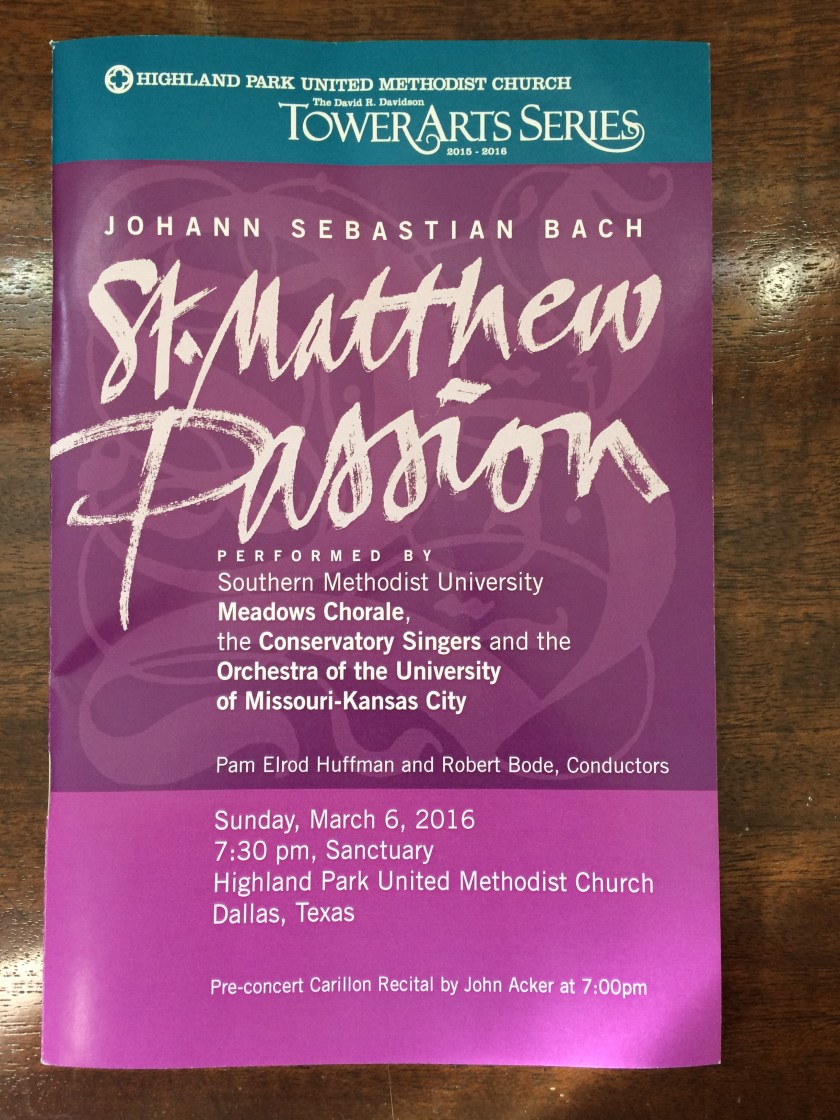
We learned of it at a chance encounter with some old friends we had not seen for a while. It would be performed on a Sunday evening about four hours away at Highland Park Methodist Church on the campus of Southern Methodist University.
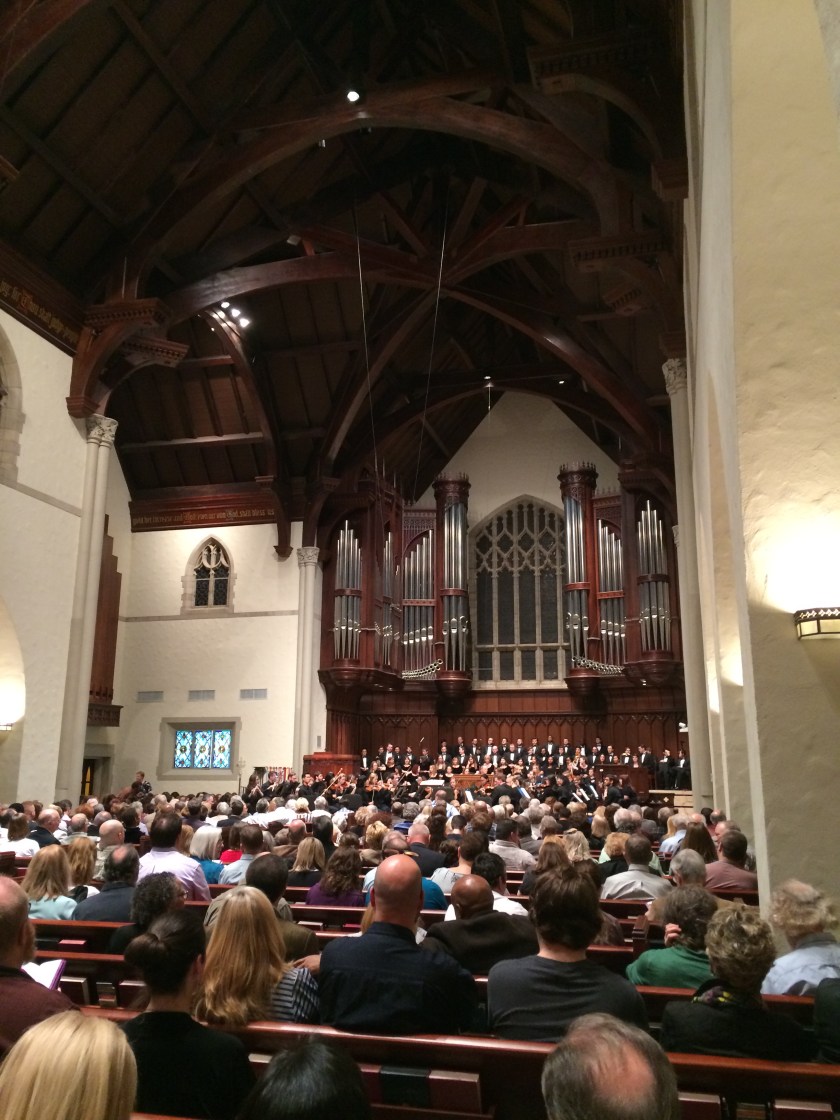
I’ve been listening, for the past several years since I discovered them, annually to one or the other of the St Matthew Passion or the St John Passion, both passion plays set to music by Johann Sebastian Bach. My focus has been on the music primarily, as I don’t know much German.
A ‘Passion’ in this sense is simply speaking, acting, or singing out the events leading to the crucifixion of Jesus. The St Matthew Passion takes its events from the Gospel of Matthew, the St John Passion from the the Gospel of John. Just as many church children’s Easter programs play out these events, Christians for many centuries have done the same. In Leipzig’s St. Thomas Church on a Good Friday sometime late in the 1720s, Bach first presented the St Matthew Passion.
Much of the wording comes straight from Scripture, from Matthew 26 and 27. But interspersed is poetry representing a view from the future of Christian onlookers engaging as spectators to the dialogue, thus:
Thus for us his most worthy passion
Most bitter and yet sweet must be.
and
Unto the dead he granted life
And put off all infirmity
Until the time pressed forward
That he for us be sacrificed;
He bore our sins’ most grievous weight
Upon the cross, long suff’ring.
The musical undertone to this oratorio is found in the hauntingly familiar hymn, “O Haupt voll Blut und Wunden“, which we know as “O Sacred Head Now Wounded”, but could translate to “O Head Bloodied and Wounded”. Originally part of a poem that addressed not only the head, but the hands, side and feet of the Lord Jesus on the cross, the melody is a haunting minor key resolving just at the end of each stanza. Bach interwove this tune into this passion at five different points throughout the piece, and it ties the whole together with its recurring theme of beautiful sorrow.
Here is an English translation of those five stanzas:
O Head full of blood and wounds,
full of pain and full of derision,
O Head, in mockery bound
with a crown of thorns,
O Head,once beautifully adorned
with the most honour and adornment,
but now most dishonoured:
let me greet you!
You noble countenance,
before which once shrinks and cowers
the great might of the world,
how you are spat upon!
How you are turned pallid!
Who has treated those eyes
to which no light is comparable
so shamefully?
Recognise me, my guardian,
my shepherd, take me with you!
By you, the source of all goodness,
has so much good been done for me.
Your mouth has refreshed me
with milk and sweet food;
your spirit has bestowed on me
so many heavenly pleasures.
I shall stand here with you,
do not then scorn me!
I do not want to leave you
when your heart is breaking;
when your set turns pale
in the last throes of death
then I want to grasp you think
in my arm and bosomui1e.
When I must once and for all depart,
then do not depart from me;
when I must suffer death,
then stand by me;
when my heart will be
most fearful,
then snatch me from the terrors
by the virtue of your own fear and pain!
At any rate, it was an experience in meditation on what Jesus did for us when he died for us. Perhaps the most moving moments were when the crowd, played by the choruses, cried “Barrabas!”, and moments later “Let him be crucified”. “Why? What evil hath he done?”
He has done good things for all of us;
He gave sight to the blind,
He made the lame to walk,
He told us His Father’s word.
He drove out the devil,
He has strengthened the troubled.
He took sinners in and embraced them, other than that, my Jesus has done nothing!
Out of love my Savior wants to die;
He knows nothing of a single sin, so that the eternal destruction and the punishment of judgment would not remain upon my soul.
Followed again by “Let him be crucified!” Chilling, echoing condemnation.
Makes me look forward to this coming Sunday, when we celebrate his rising from the dead. Really rising, nevermore to die – the first, to be followed by all who believe him.
 aaronmerrick.com